
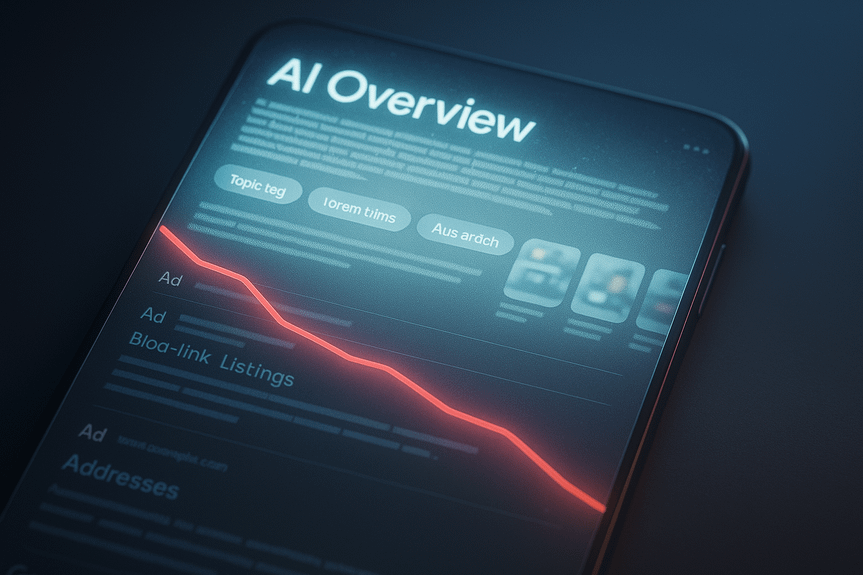

A new block in search results changes click behaviour
With AI Overviews, Google is changing how search is presented. The new block sits prominently at the top. It summarises content from the web in a short answer and links to sources. The linked article on Search Engine Land shows that when this block is visible, the click-through rate on classic organic results falls. The click-through rate on ads suffers as well. This is not limited to individual positions but affects the results on the page as a whole. The Google AI Overviews click-through rate thus shifts how attention and clicks are distributed.
The article describes what AI Overviews are meant for, how they work and which features are visible in practice. Above all, it is about the effect on user behaviour. Users get a direct answer at the top. As a result, many scroll less often to the results below. This is reflected in the measured click-through rates. The central message: the new block measurably takes clicks away from both organic and paid results.
For marketing and SEO, this offers a clear lesson. Teams need to watch search results pages more closely. They should compare their own performance with and without an AI Overview. Only then can the development be put in the right context. Below, we summarise the purpose, the way it works, the features and the practical use of the findings described in the article, with a focus on the Google AI Overviews click-through rate and its consequences.
What are Google AI Overviews?
Purpose and benefit
AI Overviews are meant to help searchers quickly. The block delivers a condensed answer to the question entered. It draws on content from the open web. The aim is to give orientation before the user clicks a result. Search is supposed to need fewer steps this way. The answer sits at the top, clearly visible, and often saves opening several pages. The article makes it clear that exactly this immediate orientation affects how clicks are distributed.
How do AI Overviews appear in search?
AI Overviews appear above the classic search results. The area contains a short text that explains the answer. There are also links to sources. These links lead to the pages where Google found the information. This keeps the connection to the web intact, even though the first answer appears directly in search. However, the placement and size of the block mean that attention goes there first. This changes the order in which users view and click content.
- AI Overviews sits very high on the page and is designed to stand out.
- The block briefly summarises information from several sources.
- There are links to sources that serve as evidence.
- The article shows that when the block appears, the distribution of clicks shifts.
- Organic results below the block receive fewer clicks.
- Ads also lose clicks when the block is visible.
- The Google AI Overviews click-through rate is therefore a key factor for performance.
- Marketing teams should monitor SERPs and take the effect of the block into account.
What the analysis shows about the Google AI Overviews click-through rate
The Search Engine Land article deals with measurable effects. It compares search results pages with a visible AI Overview against pages without this block. The pattern is clear: when an AI Overview appears, the click-through rate on organic results falls. The click-through rate on Google Ads also drops. This is because the new block answers user questions directly and concentrates attention.
The authors thus make it clear that SEO is not the only area affected. Paid clicks also decline when the AI answer appears at the top. This matters for planning budgets and targets. Some of the clicks that used to be spread across the results below are already “intercepted” in the overview. A direct click on the linked sources in the AI block is possible. Even so, the total of clicks on the classic results remains lower when the block dominates the view.
Impact on organic results
The article reports a noticeable drop in the organic click-through rate as soon as AI Overviews are visible. The reasons lie in position and format. Users see the AI answer first. Many already find the information they were looking for there. They then click less often on the entries below. The Google AI Overviews click-through rate for the classic listings is therefore lower than when no AI Overview is shown. For organic strategies, this means that the mere position in the results no longer explains the click-through rate on its own. The context of the page with an AI Overview plays a role.
Impact on paid results
Ads are affected too. The article describes how the click-through rate of paid results falls when AI Overviews sit at the top. The block takes up space and attention. Users interact with the AI answer first. This pushes ads further down, even if they still appear on the same page. The effect is relevant for advertisers. Even good ads and well-matched keywords then earn fewer clicks than without an AI Overview. The Google AI Overviews click-through rate therefore shifts not only organic but also paid traffic.
Why does the click-through rate fall when AI Overviews appear?
The article attributes the development to the presence of the new AI block above the results. The block sits at the top of the page. It answers the question directly. As a result, users have to scroll less. Many get enough context to make their next decision. Some click one of the linked sources in the overview. Others feel sufficiently informed and do not click at all. This reduces the share of clicks that would otherwise have gone to individual results.
The logic is simple: what sits at the top gets the most attention. A summarising block with the character of an answer holds that attention even more firmly. Anyone looking for a short explanation already finds it there. This changes behaviour on the page and reduces clicks on the listings below. The article points out this pattern and makes the consequences for the Google AI Overviews click-through rate tangible.
Another point is the way information is presented. The overview shows the key facts in condensed form. This helps users quickly see whether their search is heading in the right direction. But this very condensation means that classic snippets are examined less. Instead of comparing many snippets, users read the summary and then decide. That is the core of the observed change.
What does this mean for SEO and SEA in practice?
The article draws clear conclusions for practice. Teams should take the effect of the AI block into account in their reporting. Knowing your own position is no longer enough. What matters is whether an AI Overview is shown for the keyword in question. The article recommends watching the development closely and keeping an eye on performance with and without an AI Overview. Only then can fluctuations in the Google AI Overviews click-through rate be interpreted correctly.
For SEO, this means that the range of possible click-through rates per position grows. A stable position does not guarantee a stable click-through rate if the page layout changes. The same applies, in similar fashion, to SEA (paid search advertising). Even good ads with suitable landing pages can see their click-through rate fall as soon as the AI block sits at the top. This affects the planning of budgets, target values and ad delivery. Anyone who wants to compare results should take the page type into account (with AI Overview vs. without).
The findings from the article become practically useful above all in three areas:
– Assessment: Teams can explain why click-through rates fluctuate depending on the SERP layout. The Google AI Overviews click-through rate provides the context for interpretation.
– Planning: Targets for organic and paid traffic can be set more realistically once the possible influence of the AI block is known.
– Communication: Stakeholders understand better why measures do not deliver the expected click-through rate one to one, even though positions or ad quality are right.
Concrete steps that follow from the findings
The article makes it clear that observation and comparison are decisive. From this perspective, the following steps can be derived to better understand and report the Google AI Overviews click-through rate:
- Observe search results: Check whether an AI Overview appears for your most important keywords.
- Compare performance: Set results with an AI Overview against results without one.
- Read the click-through rate in context: Always assess ranking and ad position together with the page layout.
- Check trends over time: Match changes in click-through rates over time against when the AI block appeared.
- Adapt your reporting: Clearly flag in reports when an AI Overview influences the page.
- Manage expectations: Plan targets for organic and paid so that the influence of the AI block is taken into account.
These points follow the core of the article: the presentation of search has changed, and this affects how clicks are distributed. Anyone who documents this context cleanly makes better decisions. That is the practical value of the analysis described in the article.
Conclusion: context becomes a must for measuring success
Google’s new overview block sits right at the top. It delivers a short answer with links to sources. The Search Engine Land article shows that this presentation lowers the click-through rate on classic results. The effect applies to both organic and paid results. It becomes clear that the Google AI Overviews click-through rate is a factor in its own right, which teams in SEO and SEA will have to take into account from now on.
In practice, this means looking closely at SERPs, documenting when the AI block appears and assessing click-through rates in the right context. Only then can you explain why positions do not automatically deliver the expected performance. The article provides a clear basis for this assessment. It shows that search consists not only of ranking and ad position, but also of the layout of the page. That layout has visibly changed with AI Overviews. Anyone who understands this can plan and communicate targets and measures realistically.
In the end, what counts is that brands, publishers and advertisers actively follow the development. The data from the article points in one direction: when AI Overviews appear, clicks on the results below fall. That is the new starting point. Anyone who builds it into their reporting makes better decisions, and can steer their own performance transparently despite changed conditions.
(Source of the information: https://searchengineland.com/google-ai-overviews-drive-drop-organic-paid-ctr-464212)
Want more on Google and Google Ads? Then take a look at our blog:
Click here.


